



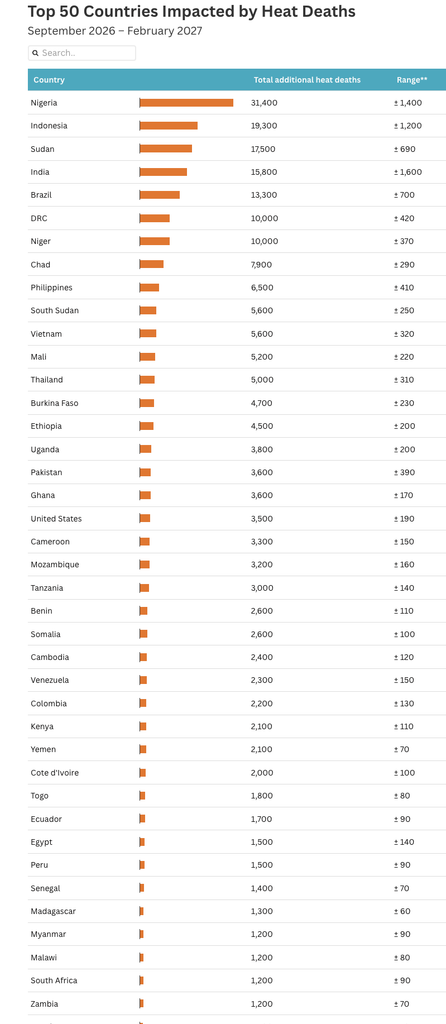
South Africa could record approximately 1,200 additional heat-related deaths between September 2026 and February 2027 as the current Super El Niño drives unusually high temperatures across the globe.
The projection, which has an estimated uncertainty range of ±90 deaths, forms part of a Climate Impact Lab report warning that extreme heat could contribute to hundreds of thousands of additional deaths worldwide.
The South African figure refers to deaths projected above the number expected in a normal year. It is not a recorded death toll.
The report, titled 451,000 at Risk: Where Action Can Save Lives During the Super El Niño, identifies the regions expected to experience the greatest increases in heat-related mortality and outlines measures that could prevent thousands of deaths.
Global temperatures could rise 1.2°C above normal
According to the Climate Impact Lab, global land temperatures are projected to be 1.2°C above normal in the coming months, largely because of the current Super El Niño.
The climate event began in June 2026 and is expected to continue through the Northern Hemisphere’s spring.
Researchers project that these conditions will result in 44% more extremely hot days than would be expected in a normal year.
They also warn that the unusually high temperatures resemble conditions that climate change is projected to make normal approximately 20 years from now.
For South Africa, the projected increase in heat-related deaths places the country within a broader warning about the effects of extreme temperatures on populations across the Global South.
Global heat deaths could reach 451,000
The Climate Impact Lab projects that 451,000 additional heat-related deaths could occur worldwide during the first nine months of the current El Niño, from June 2026 to February 2027.
Of these, an estimated 239,000 additional deaths, with an uncertainty range of ±11,000, are projected between September 2026 and February 2027.
These estimates compare the expected impact of extreme heat with the number of deaths anticipated in a normal year. They do not represent deaths that have already occurred.
The researchers warn that the figures could increase if unusually warm conditions persist beyond the current forecast period.
African countries face significant heat risks
South Africa’s projected 1,200 additional deaths form part of a wider pattern of heat-related mortality expected across the Global South.
The report identifies Africa’s Sahel region as one of the areas facing the greatest projected increases.
Between September 2026 and February 2027, the region is expected to experience approximately 66,800 additional heat-related deaths.
Nigeria accounts for nearly half of that figure, with 31,400 projected deaths.
Elsewhere in the region, the projections include:
- Sudan: 17,500 additional deaths.
- Niger: 10,000 additional deaths.
- Chad: 8,000 additional deaths.
The projections illustrate how the effects of extreme heat are expected to vary considerably between countries.
Which other countries are most affected?
Outside Africa, the Climate Impact Lab identifies several countries and regions facing substantial increases in heat-related mortality over the six-month forecast period.
Indonesia is projected to experience 19,300 additional deaths.
The Philippines, Vietnam, Thailand and Cambodia are expected to record a combined 19,400 additional deaths.
India faces 15,800 projected deaths, while Brazil could experience 13,300.
The timing of the projected deaths also differs between countries.
Between December 2026 and February 2027 alone, Nigeria is projected to experience 15,400 additional deaths, followed by Indonesia with 10,400, Brazil with 8,000 and India with 7,400.
The researchers expect heat-related mortality to continue rising beyond February in parts of the Northern Hemisphere, including India and Pakistan.
What can South Africa learn from the report?
The Climate Impact Lab says its projections are intended to help governments and humanitarian organisations identify where action could prevent heat-related deaths.
While the report provides a projected death toll for South Africa, the supplied findings do not identify specific South African provinces, municipalities or communities facing the greatest risk.
Its recommendations nevertheless provide a framework for considering how countries can prepare for periods of extreme heat.
The measures identified by the researchers include:
- Heat early warning systems.
- Health outreach to vulnerable populations.
- Cooling centres and hydration stations.
- Protections for outdoor workers.
- Expanded healthcare capacity.
- More accurate temperature forecasting.
- Wider access to cooling technologies.
The report also highlights anticipatory financing, which allows resources to be made available before the most severe impacts occur.
According to the researchers, targeted interventions could prevent tens of thousands of heat-related deaths worldwide during the current El Niño.
Extreme heat offers a glimpse of the future
Beyond the immediate forecast, the Climate Impact Lab warns that the current El Niño provides an indication of the temperatures the world could experience more regularly as climate change progresses.
The researchers describe the event as a glimpse of conditions that could become normal in approximately two decades.
Their concern is not limited to the current period of extreme heat. They argue that countries need stronger evidence about which interventions save lives, where they work and how they can be adapted to different climates and healthcare systems.
The Climate Impact Lab’s Adaptation Inventory brings together research on measures that have been shown to reduce climate-related risks.
However, the researchers acknowledge that many interventions have only been evaluated in particular locations.
They say further research and investment are needed to establish which approaches can be applied effectively across different regions.
South Africa’s projected toll highlights the need for preparation
The projection of approximately 1,200 additional heat-related deaths places South Africa within a global warning about the consequences of unusually high temperatures.
Although the figure remains an estimate, the Climate Impact Lab says the purpose of its research is to identify opportunities to act before the projected deaths occur.
With the current El Niño expected to continue into 2027, the report calls for immediate protective measures alongside longer-term planning for a hotter future.
For South Africa, the findings bring the global projections closer to home and highlight the importance of understanding how extreme heat affects human health.
Read the Climate Impact Lab report








Related Articles

Politically Aweh brings Poll Dancing to Cape Town for one night of political satire
Political promises, campaign posters and unsolicited WhatsApps are back in the spotlight...

WWE and AEW wrestler Pac dies aged 40, one day after final match
Professional wrestler Benjamin Satterley, known to fans as Pac in All Elite...

DStv launches Wethu+ with movies, local shows and live PSL football
DStv subscribers have a new channel to watch following the broadcaster’s biggest...



Petrol price could near R30 a litre in October as fuel projections worsen
South African motorists could face another major fuel price increase in October,...
