


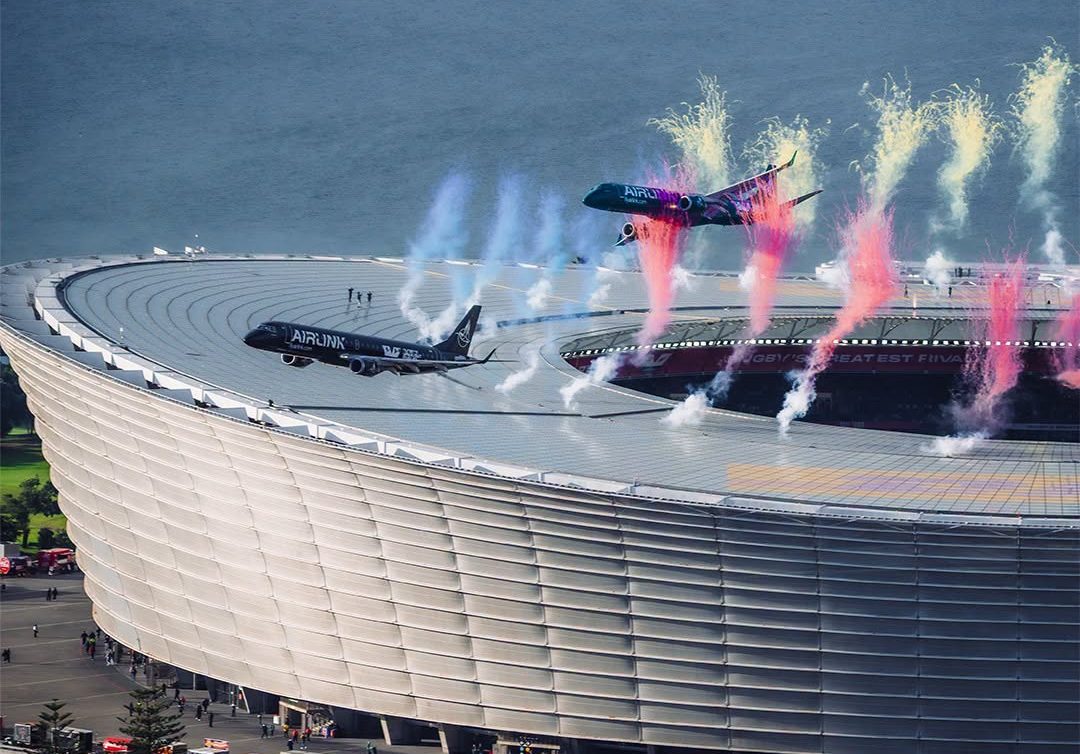
Two Airlink passenger jets flying metres above DHL Stadium in Cape Town have sparked an international aviation safety debate after footage of the dramatic formation flyover went viral.
The display took place on 29 August 2026, shortly before kick-off in the Springboks vs All Blacks Test match.
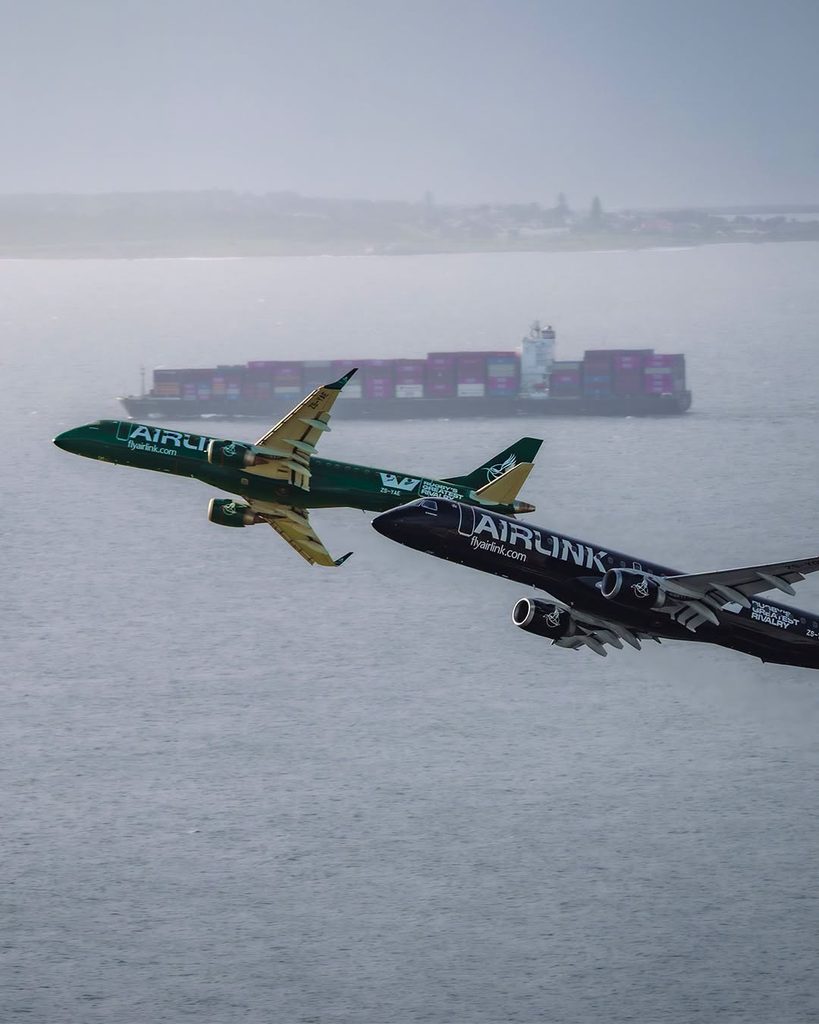
Two Embraer regional jets, an E190 and E195, flew in formation over the packed stadium, with one carrying the green-and-gold colours of South Africa and the other featuring the all-black colours of New Zealand.
Videos of the flyover quickly spread online, with the apparent proximity of the aircraft to the stadium roof leaving some viewers questioning how much clearance the jets had.
How close were the Airlink jets to the stadium?
Flight data helped provide some context to the dramatic footage.
According to Flightradar24 data, the lead aircraft cleared the stadium roof by approximately 12.5 to 14 metres, or 41 to 46 feet.
The aircraft were travelling at roughly 150 knots during the low-altitude flyover.
DHL Stadium itself stands approximately 50 metres high.
Footage also showed one aircraft climbing away after the pass, while the second flew through stadium pyrotechnics.
The striking visuals helped fuel debate outside South Africa about whether passenger jets should fly at such a low altitude over a stadium filled with spectators.
International criticism follows viral footage
International coverage raised questions about the risks associated with low-level flying over a large crowd.
Sky Sports and ABC News were among the international media outlets to describe the display as a “risky low-level flyover”.
Aviation commentators also pointed to the potential consequences of flying directly over a crowd of around 58 000 people if something were to go wrong.
Questions were also raised about how the display compared with standard international airshow rules governing low passes over spectator areas.
Airlink says flyover was fully approved
Airlink responded to the criticism by stressing that the flyover had been sanctioned by the South African Civil Aviation Authority (SACAA).
The airline said each aircraft was operated by three senior captains, serving as commander, co-pilot and safety officer.
The manoeuvre had also been rehearsed before the stadium flyover.
Black-box flight data from both aircraft showed that the flight remained within the rehearsed and legally approved parameters set by South African aviation authorities.
South Africans defend stadium flyover tradition
While the footage attracted criticism internationally, many South Africans defended the display on social media.
Supporters pointed to the country’s history of aircraft flyovers at major sporting events, including the 1995 Rugby World Cup.
The latest display added another aviation spectacle to that tradition, this time with two aircraft representing the colours of the Springboks and All Blacks ahead of their Cape Town clash.
But the extremely low clearance and images of passenger jets passing above a packed stadium have taken the conversation well beyond rugby.
What was designed as a pre-match spectacle has instead become the subject of a wider debate over aviation safety, regulation and how differently such displays are viewed around the world.





Related Articles

South Africans face major fuel price hikes from Wednesday
South African motorists face a significant increase at the pumps from Wednesday,...

Kolbe moves to fullback as Springboks name team for third All Blacks Test
Springbok coach Rassie Erasmus has opted for continuity for the third Test...

South African Shweshwe handbags are heading to Paris Fashion Week
From South Africa to Paris, Talitha Oosthuizen is taking one of Mzansi’s...



Vaping and hookah are not harmless, lung specialist warns young people
The belief that vaping or smoking hookah is harmless needs to be...
